By Afolabi Mustapha
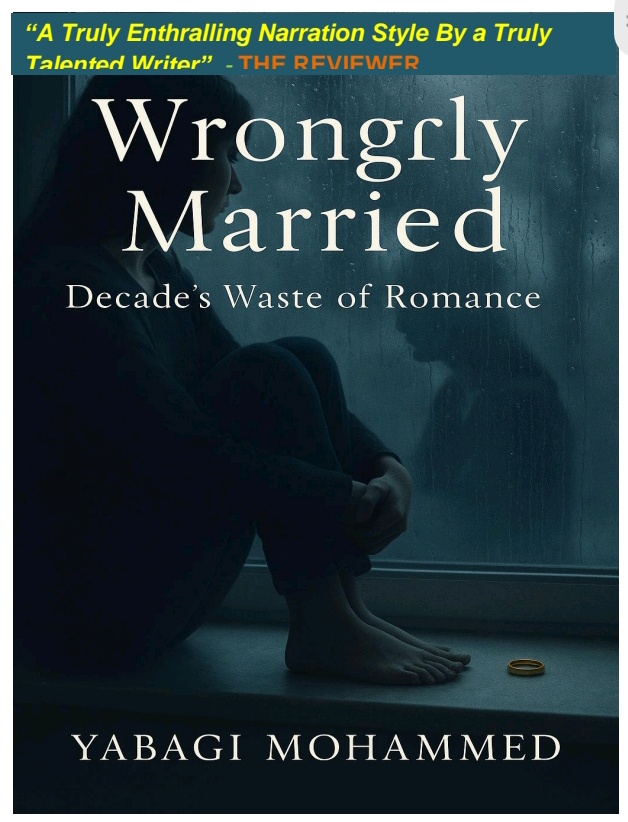
When I picked up Wrongly Married by my brother, friend, colleague and above all, my teacher, Yabagi Mohammed, I didn’t realize I was holding a mirror to a quiet, corrosive kind of loneliness that blooms inside too many shared homes.
Reading through its pages, first for academic purpose, but later for ticking the box of seeing through someone’s experience and learn from it, it felt less like observing a fictional narrative and more like bearing witness to the raw, unspoken realities of emotional neglect and marital pretense.
The book beautifully puts language to an ache that millions carry in absolute silence, and it compels me to speak directly to anyone sitting at the edge of a bed today, trapped in a cold room, questioning what love is truly supposed to feel like.
From my review of this powerful work, it is clear that emotional neglect is one of the most misunderstood forms of marital trauma because it leaves no physical scars. A marriage does not need shouting matches or public scandals to be deeply toxic; indifference is a weapon all on its own.
A clear message in the book teaches married couple or those in a relationship never settle for silence where laughter should be, or endurance where joy belongs.
The writer, who is a man, but in the book acted as a woman (the narrator), made me to understand that in marriage, men can hurt, that marriages can fail without fists or scandals, and that endurance is not always a virtue, sometimes, it’s just prolonged dying.
Reading through the book, I discovered how marriages looked so beautiful in public, whether at Asalatu or Jumat service or on a Sunday mornings at Church service but full of mess behind the curtains.
It also portrayed how either couple lived through a torrid experiences of holding on to the vows that had long broken, just to prove a point to the family or friends that you can keep your marriage, or for some, to ward off any criticism from the world and avoid be counted as one of those failed marriages that were broken due to impatient of either wife or husband.
Today’s couples must learn that when a partner is physically present but emotionally absent, it creates a grey emptiness that slowly chips away at your dignity. Good, responsible individuals can still cause immense psychological harm when they treat emotional withdrawal as a normal state of partnership.
We live in a society that deeply romanticizes endurance, often teaching us through cultural and religious scripts that staying in an unhappy union is a noble sacrifice. But a vital lesson from this text is that enduring a cold, empty partnership is not a virtue; it is a prolonged, quiet dying.
One of the most exhausting aspects of this struggle highlighted in the book is the performance of happiness, the curated photos for digital spaces and the rehearsed smiles for family gatherings. This performative partnership creates an agonizing psychological gap between the glittering image the public sees and the profound isolation felt when the front door closes.
If you find yourself suffocating in this kind of marital silence, my strongest advice is to stop editing your own truth. You cannot heal a wound that you refuse to look at, and you cannot fix a relationship by making endless excuses for a partner’s chronic indifference. It takes immense emotional clarity to look in the mirror and admit that you are hurting, that you are lonely, and that the current arrangement is breaking your spirit. Giving a name to your pain is the critical first step toward reclaiming your agency.
Once you face this reality, I encourage couples to make an intentional, honest attempt at COMMUNICATION, seeking professional counseling if possible. However, pay close attention to how your partner responds to your vulnerability. A genuine marriage requires two active participants, and you cannot water a dead plant out of mere politeness.
When a relationship systematically makes you feel invisible, the most urgent task becomes the conscious reclamation of your own identity. You must stop shrinking your personality and dimming your light just to keep an emotionally unavailable partner comfortable.
This brings me to the hardest, most liberating truth I gathered from this book, that is choosing to walk away from a hollow, toxic marriage is never an act of cowardice or weakness. Society may try to label you a failure, and guilt may whisper that you didn’t try hard enough, but leaving an unloved room is often the ultimate demonstration of courage. It is an act of profound self-preservation, a deliberate decision to safeguard your mental health, your emotional well-being, and your psychological integrity before you are completely erased.
To today’s couples, I want to emphasize that a marriage should be a sanctuary of mutual belonging, a soft place to land where your presence is celebrated, not merely tolerated. When we stay in spaces where we are treated with indifference, we accidentally train ourselves to accept less than we deserve. We normalize the neglect, and over time, our baseline for love becomes survival rather than joy. Breaking free from that cycle requires an awakening that says, “I am worthy of a love that stays whole.”
For those who are currently navigating the terrifying transition of letting go, please know that the initial quiet of a solitary life is not something to fear. It is a clean slate. It is a necessary, sacred stillness where you can finally hear your own thoughts again without the constant background noise of rejection and pretense. In that quiet space, the slow and beautiful process of solitary healing begins, allowing you to rebuild your life on your own terms.
Ultimately, walking away from a marriage that has become a graveyard for your spirit is not a betrayal of the institution; it is a declaration of loyalty to your own soul. It is the moment you decide that you will no longer participate in your own erasure.
Quoting the person that wrote Foreword, “this book, Wrongly Married is not just a memoir. It is a mirror, for
anyone who has loved hard and lost quietly. It is a hand on your shoulder, saying, I see you. I believe you. You can choose again.”
If you are married, in a relationship or planning to be in one, I urge you to pick a copy of WRONGLY MARRIED for your reading pleasure and I am sure, you will find what connect with you in it and more takeaways from the lovely book.
Its on Selar.com with cheap price – https://selar.com/1g58qm
Mustapha is a seasoned journalist and PR expert
He writes from Lokoja, Kogi State.
onwardnews247@gmail.com